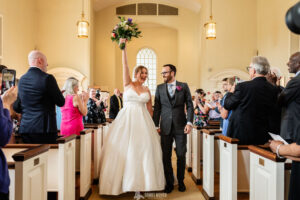
Welcome back to our conversation with Rev. Kari Olson and her husband Jason Anthony! (If you missed Part 1, check it out here.) These two made a commitment to each other and to dedicated giving when they married in 2024. Find out what inspires them in Part 2 of our conversation below.
Ashley: This feels like a gimme question for Kari, but what part of your faith informs your decision to do something like this? Did you have examples of sacrificial giving, or were there rules (i.e. you need to put aside 10%), or is it something more organic than that that speaks to why you as a Christian might have made this decision?
Kari: Probably all of the above. I think my parents talked to us about tithing 10%, but I don’t remember a ton about that. I do know when we first started getting an allowance as kids, we would get $3 a week, and it was $1 to spend, $1 to save, and $1 to church. Giving has been part of my money practice my whole life. Even when I was a student and not making a ton of money, I had a rough number in my head that I would give to whatever church I was worshipping with. When I break down my budget (now “our” budget), we have at the top the bills that have to be paid every month, rent and groceries and all of that. We put “giving” up there in that section. It’s not discretionary spending that would be the first to get cut if one of us lost our job. That’s a top priority for both of us. And separately from this gift, Jason was the one who was like, “So the money that we did get for wedding gifts; we’re tithing on that, right?”
Jason: Yeah, I grew up with the 10% rule in my family. It’s like that money doesn’t even exist. That’s a write off. Period. Pretend it’s not even there. Give first, and then you work with whatever you’ve got left. And to be fair, we weren’t rich, but we never had insecurity for food, housing, money, whatever. So we were in a stable situation. I know, not everyone can say that. But for us, it was, like, yeah, you can always just take that 10% off and then budget whatever’s left. It wasn’t even an option to do anything with that money other than giving. In my case growing up, giving was tied to the church, but I think I’ve expanded a little bit of what that might look like now.
K: Yeah, the vast majority of our giving money goes to the congregation that I serve. But some of it goes other places and this gift was separate over and above our tithing part. Some people talk about your tithe and your offerings, and the offerings are over and above the 10%. I didn’t necessarily grow up with that mindset, but I have heard it. This is the trend generally in giving, this shifting away from talking about stewardship to actual generosity in church culture.
Stewardship conveys more of the idea of how do we manage the resources that we have? I’m always encouraging people in the congregation: how can you grow in generosity? If you’re not giving regularly, could you start giving regularly? If you’re giving regularly, are you able to do an increase? If you’ve never given, could you make a gift for the first time, right? What does growth in generosity look like? And I think often our beliefs and our heart can catch up to it. If something’s important to you, put it on your calendar, put it in your budget and make it happen. If you want to become a generous person, start being more generous. If you want to know what’s important to somebody, look at their calendar and their budget.

A: You’re absolutely right. For people hearing this story, what would your hopes be for them? They read about Kari and Jason and this lovely thing that y’all did. What would you hope to inspire?
J: Give it a go. See if you can save some money to give away. I think you might surprise yourself. More often than not, we can work with less. We can write off a bit more of your income, make little cuts here or there. It’s fun to see it snowball. It’s like, oh, we ate out one less time this month, we were able to put that towards our giving goal and look, that’s bigger now. Like I said, like, one of my weaknesses is that I feel like I can’t give something a go until everything’s all set up and ready to go. So if that’s you too, maybe just give it a try, you might surprise yourself.
K: I would hope that it would inspire people who wouldn’t otherwise realize that they could make a more significant gift that maybe you actually can. Because I wouldn’t have thought of myself in that category. I could have done more than I realized with some intentionality. If you plan, it’s okay if it takes some time to get there; we spent about a year saving up to be able to do it. I wouldn’t have thought of myself being somebody who could make a more significant capital contribution, but I’m really glad that we were able to see that we could. And so I hope that that inspires other people to consider. If you’ve never thought about it; maybe you could.
Has this story inspired you to think creatively about giving? The Common Place is growing in so many ways as we continue to meet the needs of our community. Find out how you can be a part of TCP’s mission of welcome in the heart of Southwest Philadelphia! Sign up for our communications right on our webpage or make a tax-deductible donation today.